1300 851 842ua.moc.snoitulostniophgih@nimda

Home/Knowledge/Thermography basics

Save BIG Money on Home Energy Bills

Thermography basicsPublished 22 February 2026Reviewed 9 September 2026

The short answer

A thermal imaging survey of a home shows where conditioned air is escaping and where heat is getting in — missing or slumped insulation, gaps around downlights and ceiling penetrations, poorly sealed doors and windows, and uninsulated ducting. Because the camera reads surface temperature directly, it finds the specific locations worth sealing rather than leaving you to guess, which is what makes the remedial spend worth making.

At Highpoint Solutions we can show you, through the lens of our thermal imaging camera, exactly how and where to improve the energy efficiency of your home.

Heating and cooling is the largest single component of most Australian household energy bills. The reason that money is being spent is rarely the appliance — it is the building letting the conditioned air straight back out.

What the camera actually sees

An infrared camera does not see through walls. It reads the surface temperature of everything in view, and surfaces reveal what is happening behind them.

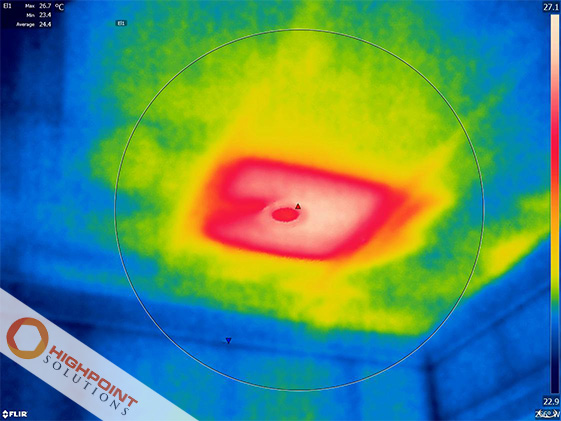
On a hot day with the air conditioning running, a ceiling with insulation performing correctly reads cool and even. A section with missing, slumped or displaced batts reads noticeably warmer, because heat from the roof space is conducting through. The camera renders that as an obvious patch with a defined edge.

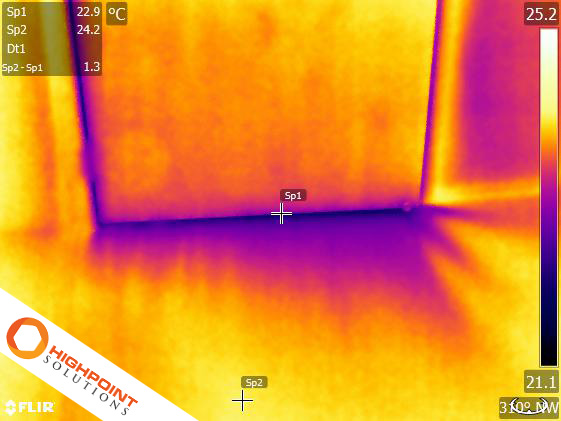
The same logic applies to air movement. Conditioned air escaping around a ceiling penetration cools the surrounding surface in a plume that is unmistakable in infrared and invisible to the eye.

What a survey typically finds

  • Missing, slumped or displaced ceiling insulation. Extremely common, particularly where trades have been into the roof space for wiring, plumbing or antenna work and not put batts back.
  • Downlight penetrations. Older fittings require clearance from insulation, which leaves a hole in the thermal envelope at every fitting.
  • Ceiling and wall penetrations. Exhaust fans, ducted outlets, plumbing stacks, cabling.
  • Door and window sealing. Perimeter gaps and failed weather seals.
  • Ducted air conditioning losses. Uninsulated or damaged flexible ducting in the roof space, and leaking joints — conditioning a roof cavity at full cost.
  • Wall insulation gaps in cavity or clad construction.
  • Thermal bridging through un-insulated structural elements.

Why the survey is worth more than a general recommendation

Anyone can tell you to insulate your ceiling. The reason that advice frequently produces disappointing results is that the ceiling is already insulated — just not in the four square metres above the hallway where somebody moved the batts twenty years ago.

A thermal survey converts "improve your insulation" into a list of specific locations. That is what makes the remedial work worth doing: you spend money where the loss actually is, and you can re-image afterwards to confirm the fix worked.

Conditions matter

A thermal survey needs a temperature difference between inside and outside to reveal anything. Roughly 10 °C or more across the building fabric gives good results.

In Queensland that usually means a summer afternoon with the air conditioning running, or early on a cool winter morning. A mild day with the doors open produces a flat, uninformative image — which is why a competent surveyor will discuss timing rather than simply booking the next available slot.

What else turns up

Because the survey scans the whole building fabric, it routinely finds things the homeowner was not looking for:

  • Moisture ingress and dampness, which reads cool through evaporation and is confirmed with a moisture meter
  • Plumbing leaks inside walls and slabs
  • Live termite activity, which produces a warm signature against surrounding structure
  • Electrical switchboard faults

For most homes this is the more valuable half of the survey. Energy loss costs money slowly; water and termites cost a great deal quickly.

Reasonable expectations

Thermography identifies where losses are. It does not quantify the dollar saving from fixing each one — that depends on your tariff, your usage pattern, the climate and how the house is occupied.

What it does is remove the guesswork, so remedial spending goes to the defects that exist rather than the ones a general checklist assumes.

Our thermal imaging property inspections cover the building fabric, moisture, insulation, termites and the switchboard in one visit, with two levels depending on whether you need a written report.

Written by the team that does the work — ISO 18436-7 Category 2 thermography, IRATA Level 3 rope access and QBCC licensed waterproofing. If your situation does not match anything above, call and describe it; we will tell you straight away whether we are the right people for it.

Get started

Tell us what you're trying to find — or reach.

Most jobs start with a phone call and a photo. If it's a leak, a hot board or something you can't get to, we'll tell you straight away whether we're the right people for it.

Phone1300 851 842
BaseEumundi, Sunshine Coast QLD
CoverageQLD-wide · Australia on request
HoursMon–Fri 6:30am–5:00pm
Request a free quote